Posts from the ‘Uncategorized’ Category
I’ll update this when I’ve got time later, but while I remember:

… can be found here: http://arstechnica.com/staff/fatbits/2009/05/hypercritical.ars
A great article on how Apple has pinned down the affective dimension of design. Even though it’s obviously a tech sector article it’s still got immense parallels for stakeholder engagement, summed up by:
Have you ever met someone who holds strong opinions but is completely incapable of explaining them? “I really hated that book.” “Why?” “I don’t know, I just didn’t like it.” Who wants to be that guy? That’s no way to live.
Maybe you’re afraid you don’t know enough about anything to trust the validity of your criticism. Putting aside the extremely small likelihood that this is actually true, it shouldn’t stop you. Developing your critical thinking skills necessarily involves applying your critical thinking skills to…your critical thinking skills. It’s recursively self-healing!
Up until now I’ve been thinking about stakeholder engagement problems mainly from the point of view of helping them to understand what we present to them, but here’s the same problem from the exact opposite perspective! We also need to help them tell us what they are thinking…
Relational embeddedness is more important than structural embeddedness.
Or, put another way, if we accept that it’s not what we know but who we know, the above proposition advances this to suggest that it’s not who we know, but how we know them. Considered from the perspective of getting things done within an organisation…
Dissertations (UG and PG) this time.
Looking through Jason Santa Maria’s post reblogged reminded me of photoshop tennis, which seemed to be popular a few years back.
His pretty sketchy post is obviously in the constructivist schools (much like this whole tumbr experiment is for me!), but then he jumps into the very much constructionist view of “bouncing ideas backwards and forwards between people” to generate a solution.
I wonder if there’s something the “tennis” model of our SNA work if we do adopt the constructionist view? Interesting
http://jasonsantamaria.com/articles/reflections-on-layer-tennis
Notes from Rutkowski and Smits’ GDSS paper on the constructivist school:
“The cognitive development rests both on the principles of organisation (i.e. scheme’s hierarchial integration) and on the principles of adaptation (i.e. scheme’s assimilation and accommodation). Paiget (1960) pretends [???] “that the maintenance of an equilibrium between the organism and the environment, can be defined as a balance of assimilation and accommodation” (Kohlberg, 1984, p. 14).”
^^ Accommodation must be reorganising – revising the constructs in light of new info.
^^ The parallals with bloom’s taxonomy in learning theory are obvious…
“Constructivists focus on the interactive-brian side of making sense.”
“First individuals “incorporate proactively the inputs” received from the environment
…
Second, they construct their “personal constructs” on the base of their experience
…
Third, they meaningful organise those constructs”
“the cognitive organisation is perceptable through language”
^^ So discourse analysis can be placed here, and freelisting as a basic starting point. More sophisticated tools would be:
“Because knowledge is assumed to belong to various levels of cognitive awareness, individuals can be helped, with methodological tools as, for example, repertory grids, downward arrow or personal construct laddering, to organise their knowledge about the meaning of the world”
And then thepaper heads off into a discussion of therapy…
” it is not the mind of a single individual that provides whatever certitude we possess, but relationships of interdependency. If there were no interdependence – the joint creation of meaningful discourse – there would be no ‘objects’ or ‘actions’ or means of rendering them doubtful.” Gergen, 1994
^^
so this will be a good treatise of the constructionist school (constructionism), then.
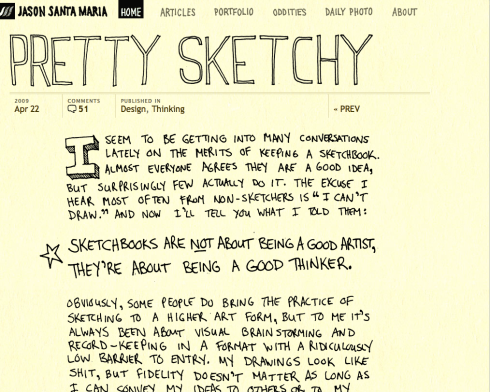
I might be in love with the design for Jason Santa Maria’s latest article, “Pretty Sketchy”. Everything that can be, from the article’s text to the navigation to the logo, is in a sketchbook style. And he’s right:
Sketchbooks are NOT about being a good artist, they’re about being a good thinker.
It’s taken me ages to realise that there’s a difference, but it seems:
The constructivist school came first and is characterised by PCT. Meaning is ascribed internally within an actor as a consequence of their own experiences. An individual can, however, change their view of the world as a consequence of their interactions with others. Meaning is therefore developed within a social group as a consequence of influence and negotiation.
Then constructionism came along and is characterised by development of meaning directly from the interactions of actors. Meaning is collective and developed directly from social interations. This school would seem, therefore, to assume that an individual can’t understand their world in isolation form others, which seems somewhat odd. After all, with this view, what would be the point of skiddling?
Constructs span both, it’s just a question of how they are developed and reorganised…
But, if we’re talking about value theory and judgement among a group of stakeholders, then both have to be considered. This suggests that interpretation of artefacts has to be considered from a fundamentally different perspective if we’re considering an individual or that individual’s function within a group. We must decide if we assume knwoldge to be generated first by individuals and then shaped by individuals’ interactions, or if comes solely from the interactions of individuals. Or maybe it’s bits of both…
It’s interesting that the learning theory has only recently hooked onto the social aspects of learning (Laurillard) – i.e. the construcitivist view – and all the reflective learning (reflective design theory; schon’s double loop learning, etc.) are firmly grounded in the constructionist view.
Does this mean that SNA hasn’t yet been meaningfully looked at from the point of view of knowledge generation, or am I missing something??? Having said that, the Tipping Point stuff assumes, through the action of “salesmen,” a constructivist stance. Although, from memory, it ever acknowledges this. I may have to read it again…


 Dr. Derek S. Thomson