Posts from the ‘Uncategorized’ Category
… with the value of their lost market capitalisation caused by the Gulf oil spill.

I do rather like these things. Puts everything in perspective.
Source: http://www.visualeconomics.com/what-bp-could-have-bought-with-all-the-money-they-lost/
The specter of the two-year degree has raised it head again. With many institutions now (officially or otherwise) already running three semesters (i.e. teaching all year round), then implementing such a thing actually won’t be that difficult.
But what would it mean for Scottish institutions? Would four years become three? And for the academics whose summers are already crammed full with research and teaching prep, where will these activities now happen? The evenings and weekends are already full.
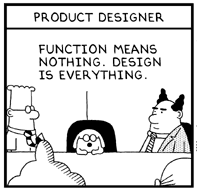
I see Dogbert as Jonathan Ive and the product as the iPhone4 in this image…
Here’s the Abstract for a paper recently accepted to the HaCIRIC 2010 conference. It establishes the premise for my Benefits Quantification project. Basically, although there’s lots of guidance out there asking healthcare investors to assess and demonstrate the “benefits” realised by their efforts, this is seldom done. When it is done, it is done poorly.
Hence the need for a structured and reasonably reliable method of quantifying benefits (a difficult thing to do when many of them are intangible and amorphous)!
QUANTIFYING THE BENEFITS OF HEALTHCARE INFRASTRUCTURE INVESTMENT
D. Thomson, L. Pronk, C. Alalouch, A. Kaka
ABSTRACT
UK government seeks the use of Benefits Realisation Management Processes (BRMPs) to direct capital investments that are technically complex and must satisfy a diverse range of stakeholder needs. Although BRMP frameworks are available, methods to inform them with reliable quantifications of stakeholders’ judgements of benefits realisation are currently absent.
The articulation of benefits in current practice is reviewed to establish the context of benefits realisation. Benefit-related healthcare policy is reviewed by desktop survey of government publications and NHSScotland business cases. A conceptual framework for benefits quantification which characterises benefits realisation using stakeholders’ judgements and perceptions of benefit worth is contributed.
Translation of stakeholder judgements of benefit provision magnitude into indications of benefit worth by means of benefit functions is explored and related to BRMP operation. The use of utility functions to translate judgements of magnitude into representations of ‘worth’ is found to be an appropriate premise for benefit quantification.
KEYWORDS
Benefits; Investment; Judgement; Stakeholders; Utility.
I ran an initial “whole life value” workshop for this project a few weeks ago. Used all the standard Value Management tools, and a few new ones, to explore the priorities and issues framing the delivery of this school; with its new form of governance.
Interesting to see its profile rising…
http://www.timesonline.co.uk/tol/life_and_style/education/article7116042.ece
So, the talk is that quantitative easing only stoked stock market trading in the UK and didn’t make it down to the man on the street. The increased access to credit, as demanded QE’s Keynesian view, never made it out of the banking sector. So, growth never happened. We weren’t able to spend our way out of a recession, but at least we (for the moment, at least) have been shielded from the inflationary effects of cheap money.
The current talk is, particularly if the EU also embark on a programme of QE to protect the Euro, that we are heading for a double-dip recession and, right now, we’re in the infamous dead cat bounce.
Anyway, the point of this post? Just to point out this really rather excellent video (the Keynes’ General Theory as the Gideon Bible analogy is particularly sweet) that sums up the Keynesian view vs. the Hayek view. For the record, I’m in the latter camp. Current economic policy is in the former.
For my students specifically: watch out for the context of construction investment around the 4:40 mark…
Tonight I find myself mostly outraged that the British Library is charging £40 to digitise a thesis from its collection when it was free a year ago…
Time for a cost-benefit analysis of my own wallet…

Love this.

It’s for a paper I have to submit tomorrow. Question is, can you see where the interface is between the client and the construction project team? That’s the point I’m trying to make. Real data, from some consultancy of mine…
I rather like this dashboard:

Although it does indicate the trend, it is limited in that it does not present historical data – you have to click through for that. If the orientation were changed and Tufte’s sparklines added, then things would get interesting…

 Dr. Derek S. Thomson